
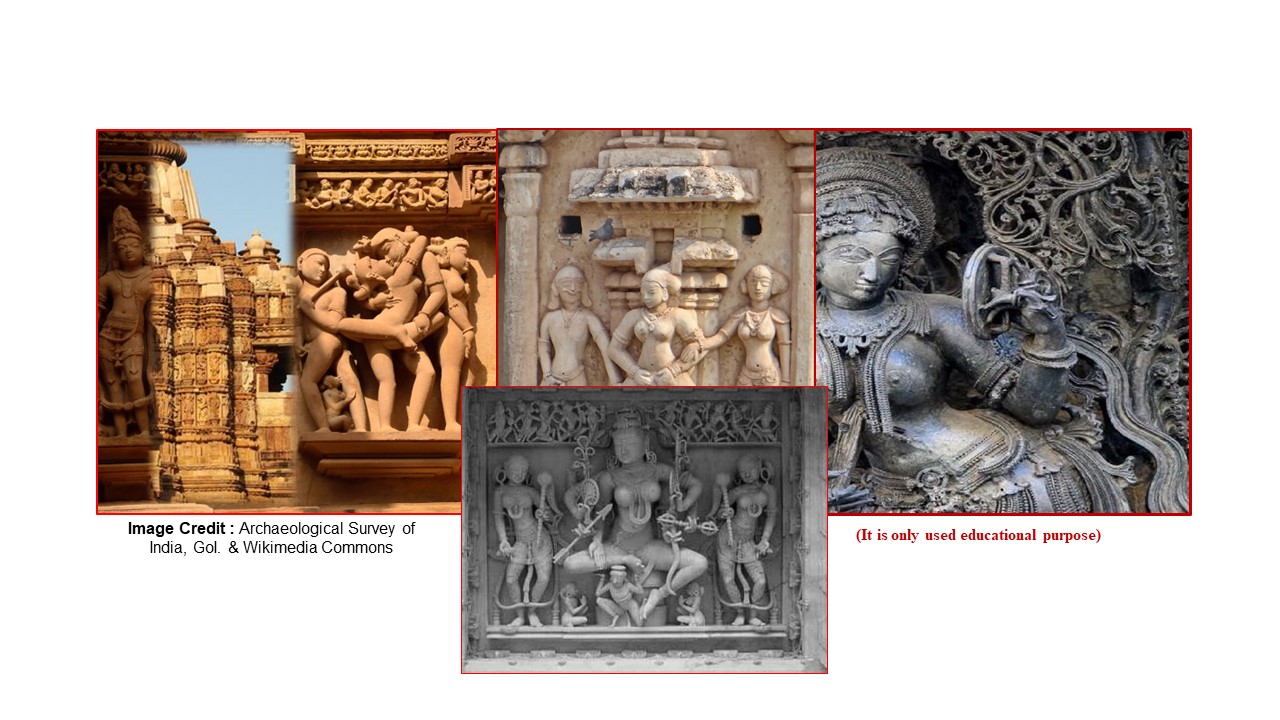
The culture and civilization of India directly and indirectly influenced world civilizations and human development. However, during the last 800-900 years, due to invasion and the rule of different invaders and looters over large/some parts of India, its true intellectual impact on the world decreased badly. India has been constantly presented as a poor, uneducated, and uncultured civilizations. This happened mainly because of political interests, foreign rulers, and later after independence for more than 50 years by a leftist ecosystem that, from inside, disliked Indian civilizations but presented their work as liberal. In this process, such intellectual groups tried their best to dilute almost all positive aspects of Indian culture. All cultures have drawbacks and social issues, and India is not an exception, but this ecosystem never presented the excellent and exceptional contributions of Indian civilizations. Many achievements of India were either credited to foreign rulers or manipulated in a very smart way.
Among many such examples of manipulation, the naked and erotic statues and art found on ancient temples (India, Nepal, Pakistan, Bangladesh, Afghanistan, Bhutan etc. Once a part of Bharat/India) are often presented as proof that kings and people in ancient India were very attracted to sex, that open sex was part of Indian civilizations, and that any kind of sexual behavior was allowed, similar to some trends in modern Western societies. Some even wrongly claim that ancient Indians had sex with animals for pleasure by referring to art on temples of Ellora, Ajanta, Khajuraho and many more. Other so-called Indologists and intellectuals, who try to appear soft and sympathetic to Indian culture, explain that these arts were created on the instructions of ancient kings at a time when many people were losing interest in family life and becoming sannyasis by leaving everything to search for God. According to them, the sculptures were meant to stop people from taking sannyasa and to teach them the importance of sex for the proper growth of the next generation and civilizations. Many Indian and foreign professors from JNU, JU, AMU, Harvard, Columbia, MIT, and other universities have always given such explanations, as they have their own vested interests and want to prove the western way of life superior.
But, the true meaning of these sexual arts, nude statues of young women, and Kamasutra-type carvings found even today in many southern Indian temples (also@newly built temples) on entrance gates, walls, and before the main deity is that they were a test of how much a person is still attached to worldly life. If you enter a temple and are still distracted by these arts, by beautiful women with naked bodies, sexual scenes, erotic statues then you are not yet eligible for self-realization and the understanding of God. But if you see them simply as stone and sculpture, without disturbance, then you are on the true path of understanding God and His creation. It is very important to note that in most temples such arts appear on the entrance or outer walls, and sometimes in a few inner rooms, but never in the room of the main deity. This truly means that as you proceed on the spiritual path, you must leave everything outside even the greatest pleasure, which is sex, and your worldly wealth symbolized by elephants, horses, flowers, fishes, etc. It symbolizes that wealth, sexual pleasure, and even your family cannot go with you. You have to leave everything before searching for God and self-realization. The other Indian spiritual meaning of such carvings is briefly pointed below..
By Dr. Santosh K. Tiwari
Further Reading/ Ref.
Dr. Jagadish December 01, 2025
It's a very insightful article and brings up the actual spirit that lies behind our culture and ancient civilization. Particularly, It could help foreigners to understand our culture in a right way. As it is mentioned in article, after independence, nearly 50 years many leftist parties didn't portrayed our identity and culture in right way.
Gururaj K November 30, 2025
This was such an eye-opening read. I really appreciate how beautifully you explained the deeper spiritual wisdom behind these sculptures. Most of us grow up hearing only the superficial or distorted interpretations, so reading about the symbolic journey from worldly attachments to inner purity felt genuinely refreshing.
I especially liked the point that these carvings are placed on the outer walls-almost like a reminder that the path to the divine begins only after the mind rises above distractions.
It is a perspective that brings dignity to our heritage, instead of the usual sensationalism. Thank you for presenting it in such a balanced, meaningful way. It makes me want to revisit these temples with a new sense of understanding and respect.
Rajeev Ranjan Srivastwa November 30, 2025
Rightly narrated Dr Tiwari (my dear Guru)
It is a fact that the interpretation of these sculptural visuals on mostly the outer walls of ancient temples had been publicised in a way to diminish the importance and mainly the impact of Indian culture across the globe but prominantly in the Indian society itself. In the ancient time time there were plenty of people who were in pursuit of self realization while with time as the Mughals invaded Indian just from beginning of Gandhaar to every possible end point, the image, the meaning got diluted, and this number also got reduced significantly (in fraction/percentage of the total population).
Whatever is carved on stones had been a source of knowledge for the entire civilisation, I am adding some examples here.
- In Konark's Sun temple, even though it is made in approx 1250 AD, on the outer walls there are sculputres for right poses of having sex, for better conceiving.
- Minute glimpses of naked sculptures could be seen even in Sanchi's stoopa.
and so on and so forth.
So in a nutshell, the naked sculptures are a kind of first gate of Chakravyuha that a person should pass first (because in the physical world sex is probably the ultimate source of pleasure) and there is possibility of unleashing the ultimate source of creation.
Thank you for highlighting such an important, hidden, mis interpreted part of our culture and civilisation.
KB Rao November 30, 2025
Very interesting.
Marc Monthioux November 30, 2025
Hello Santosh
Thank you for this interesting analysis.
It explains meaningfully the existence of erotic sculptures on so many Indian temples.
As you do not provide any reference, I disagree with one comment you made, but I may be wrong: you say "India has been constantly presented as a poor, uneducated, and uncultured civilization". I doubt it: how could a civilisation having been able to provide such a deep input to worldwide spirituality, and to produce so many marvels in many arts be seriously considered as "uneducated and uncultured"?
On the other hand, yes, MODERN India society (say, India from 19th an !early 20th centuries) may have been considered so by foreign (mostly Western, I guess) countries, because all the marvels and spirituality above-mentioned were coming from the past, with no recent creation of new marvels. More importantly, science and technology, which are the criteria to evaluate how far a country is "civilised" in modern times, were inexistant.
And the same happened with many other countries, in Africa, South America, Asia (including China, of course) as a premise to colonisation.

Public accountability in sci...
View now
Every year, people celebrate the birth of tiny dog puppies symbols of jo...
View now
Science matters to everyone because it qu...
View now