
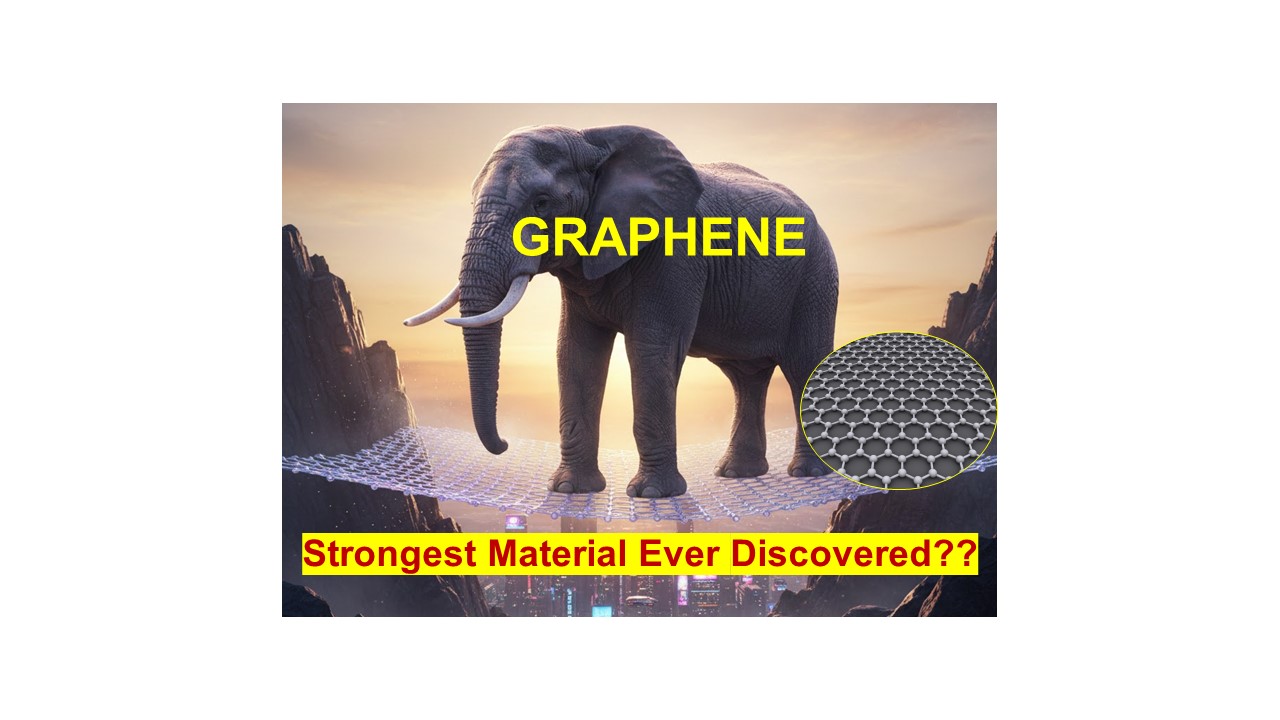
Graphene: The Strongest Material Ever Discovered
“If you think diamond is the strongest material, you are mistaken. The strongest known material is graphene. Graphene is a single atomic layer of graphite, and graphite itself is made up of billions of stacked graphene layers. This structure is illustrated in the Figure below.”
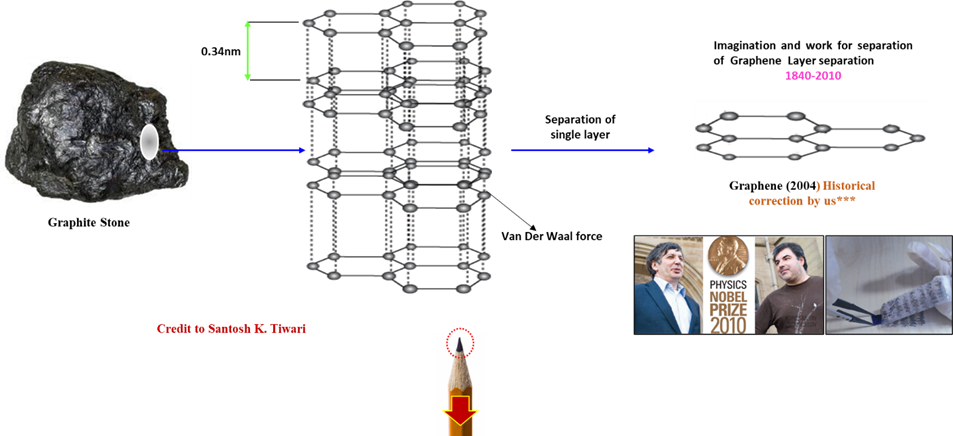
Graphene, a material only one atom thick, is widely regarded as the strongest material ever discovered. It is made of carbon atoms arranged in a flat, honeycomb-like structure. Despite its extreme thinness, graphene combines exceptional strength with light weight, high flexibility, and excellent electrical and thermal properties, making it one of the most important materials of modern science. Graphene was experimentally discovered in 2004 by scientists Andre Geim and Konstantin Novoselov at the University of Manchester, UK. Using a simple mechanical exfoliation method, often described as the “Scotch tape technique”; they isolated a single layer of carbon from graphite. This breakthrough earned them the Nobel Prize in Physics in 2010, as it opened the door to a new class of two-dimensional materials.
What makes graphene extraordinary is its atomic bonding and structure. Each carbon atom is strongly bonded to three neighboring atoms through covalent bonds, forming an almost perfect lattice. This allows graphene to be about 200 times stronger than steel, while being incredibly light. A sheet of graphene as thin as plastic wrap could theoretically support the weight of a large vehicle without breaking. Beyond strength, graphene shows remarkable general properties. It conducts electricity better than copper, conducts heat better than most metals, and is nearly transparent, absorbing only about 2% of visible light. It is also flexible and stretchable, meaning it can bend without losing its properties; an unusual combination rarely found in traditional materials. Given in Table

Scientists note that “strongest” refers to resistance to stretching, not hardness. While diamond resists scratching, graphene resists tearing. Today, graphene is being explored for use in aerospace, electronics, energy storage, water purification, and biomedical devices. The biggest challenge remains large-scale, low-cost production. In essence, graphene has shown the world that the future of materials lies not in thickness, but in atomic design.
No comments yet. Be the first to comment!

Rechargeable batteries are essential to modern society, quietly enabling...
View now
Quantum computers represent one of the most profound shifts in the histo...
View now
Within 50 years from now, the way humans are born may l...
View now