
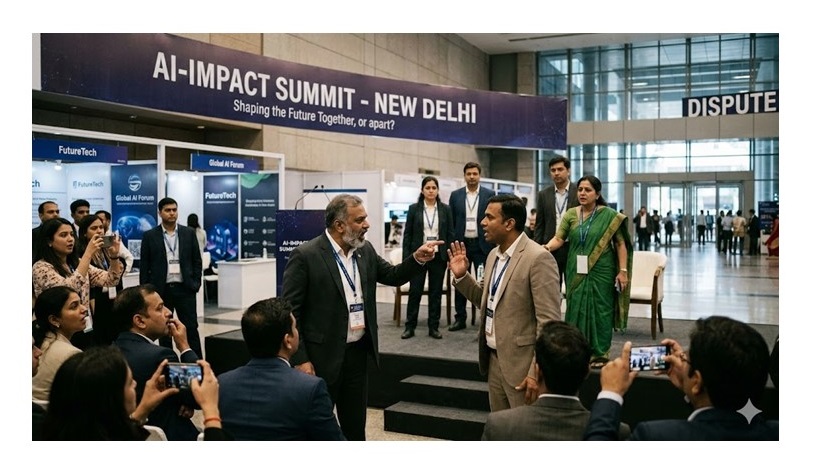
Public accountability in science is very essential. If a serious lapse has occurred at a nationally visible AI event in Delhi under the Government of India, a transparent and rigorous investigation is not optional. Scientific integrity is non-negotiable. Any exaggeration and misrepresentation of research capability, technological readiness, claims damages institutional credibility and, more importantly, erodes public trust in Indian science. However, intellectual honesty requires that criticism not stop at one individual. The ecosystem must also be examined.
It is very important to note that a large number of private universities operate under structural contradictions. Administrative leadership is often not deeply rooted in research culture, and institutions are projected as centers of excellence. Metrics are aggressively demanded; publications, patents, prototypes, rankings while sustained investment in advanced instrumentation, stable funding, lab autonomy, and trained technical staff remains inadequate. Expectations resemble those of elite research institutes; infrastructure resembles teaching-focused colleges. This mismatch creates a performance paradox. In such systems, leadership bears significant responsibility. Removing one person does not solve a structural problem. The academic job market in India is extremely competitive and uncertain. Many faculty members compromise, not out of intent to mislead, but out of fear of losing employment. Questioning unrealistic targets and highlighting infrastructural gaps is often interpreted as incompetence. Survival becomes a priority. When optics are rewarded more than substance, performative science quietly replaces rigorous science. Here, I do not justify misconduct, but I am truly explaining how vulnerabilities develop.
The concern extends beyond academia. A notable share of startups relies on marginal modification of imported technologies while being presented as deep-tech innovation. When branding overtakes originality, exaggeration becomes normalized. The distinction between incremental engineering and genuine R&D becomes blurred in public perception. Selective outrage weakens credibility. If one professor or one institution is scrutinized, the same standards must apply to public universities, private institutions, incubators, startups, and funding bodies alike. Accountability must be systemic, not symbolic. The deeper issue is not a single event. It is the gap between ambition and capability. India aims for leadership in AI, advanced materials, semiconductors, and strategic technologies. That goal demands more than announcements and events. It requires research governance reform, merit-based leadership, long-term investment in cutting-edge infrastructure, protection of academic freedom, and evaluation systems that reward depth, reproducibility, and integrity over visibility.
Blame can address an incident. Only reform can strengthen a nation’s scientific foundation.
Santosh K. Tiwari, PhD
No comments yet. Be the first to comment!

Every year, people celebrate the birth of tiny dog puppies symbols of jo...
View now
The culture and civilization of India directly and indirectly influenced...
View now
Science matters to everyone because it qu...
View now